Matthew 25:35-40 NIV
For context, the speaker, the “I,” is Jesus.
For I was hungry and you gave me something to eat, I was thirsty and you gave me something to drink, I was a stranger and you invited me in, I needed clothes and you clothed me, I was sick and you looked after me, I was in prison and you came to visit me.’
“Then the righteous will answer him, ‘Lord, when did we see you hungry and feed you, or thirsty and give you something to drink? When did we see you a stranger and invite you in, or needing clothes and clothe you? When did we see you sick or in prison and go to visit you?’
“The King will reply, ‘Truly I tell you, whatever you did for one of the least of these brothers and sisters of mine, you did for me.’
It cannot be right or just that the poorest Americans are harmed by the One Big Beautiful Bill Act.
According to Feeding America estimated 47 million Americans, including 14 million children, experienced food insecurity—a sharp rise from prior years and the highest level in nearly a decade.
Rates soared especially among low‑income households, with over 27 percent of adults reporting food hardship, and Black and Latinx households disproportionately affected at rates above 30 percent according to Urban Institute.
From personal experience I can say that you may be unaware of persons who are food insecure.
For the first 5 years or so of becoming a teacher I struggled to buy enough nutritious food for my daughter and I.
At that time, my church gave out bread to the community and I received a portion as well. Have you ever had a toasted bagel with peanut butter and a cup of tea for dinner? Filling! And, delicious.
Feeding America estimates that Americans collectively faced a $32 billion weekly food budget shortfall in 2023 (about $22 per person per week).
The recently enacted One Big Beautiful Bill Act (OBBBA) slashes SNAP funding (formerly known as Food Stamps) by $186–279 billion, tightens eligibility via stricter work requirements, shifts costs onto states, and delays updates to benefit levels.
According to an article in Vox the OBBBA is projected to cause over 3 million Americans to lose benefits, and to contribute to worsening hunger especially in rural and high‑need communities.
The non-partisan Congressional Budget Office (CBO) projects that the OBBBA will reduce SNAP participation by an average of 3.2 million people per month over the next decade and decrease overall SNAP spending by $285.7 billion over the same period.
However, finally, the CBO also estimates that the OBBBA will increase the federal deficit by $3.4 trillion over the next decade.
Faith‑based groups and food banks are mobilizing and are already in place to fill the gaps—expanding capacity, adding distributions, and offering wrap‑around services such as nutrition education, health referrals, and choice‑based pantry models.
In choice-based pantry models the participants make selections. This is a great for the user because they only receive the supplies or food that they will actually eat or use.
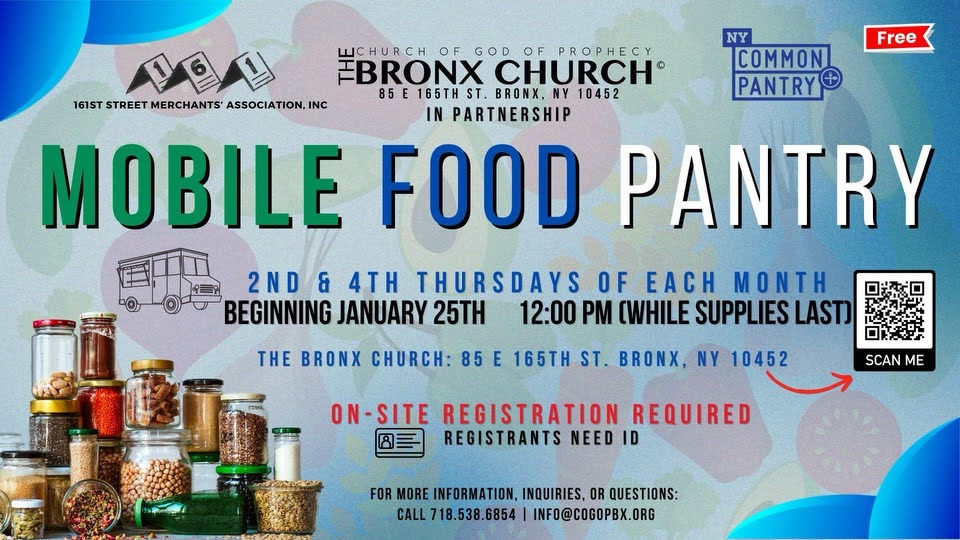
Our church offers a “mobile” pantry option. “Mobile” means that the food items are brought in but not kept on hand by our church. We gather those items that are brought to us and pre-package them into bags.
Starting at noon, we give them away. We simply don’t have the space to keep items on shelves.
If you have a need, or, if you know someone who does, PLEASE drop by 85 East 165 Street, Bronx, NY 10452 on the 2nd and 4th Thursday of the month starting at noon.
You’ll be greeted by friendly faces and you’ll walk away with the elements of a meal.
We realize that our efforts and those of other pantries are vital lifelines. For example, we observe that with just our small pantry efforts, the lines are growing.
Thank God, so are the volunteers.
However, we, nor any pantry can fully replace the scale, stability, and coverage of federal programs.
Small charities like ours, and even much larger ones tend to lack the infrastructure, consistent funding, and breadth to meet national needs—especially in underserved rural or high‑disparity regions.
Without renewed public policy support, ad hoc measures, like a local pantry, may soften the blow—but federal safety nets remain essential to adequately feed and protect vulnerable Americans.
A more just, inclusive OBBBA would make changes to the way the poor are treated in this bill.
To do otherwise is to look away while Americans go hungry.



 Help! Love, MOM
We’d love it if you’d leave a comment.